Social media management was supposed to get easier. Over the last decade, we’ve been promised efficiency, automation, and leverage. And yet, for most social media managers, the day-to-day reality still feels strangely manual.
If you manage multiple platforms, you already know the routine. Content gets created, tweaked, reformatted, uploaded, scheduled, and reviewed — again and again. The tools have changed, but the work itself hasn’t evolved nearly as much as we like to believe.
Consider a simple example. A brand produces one hundred pieces of content in a year and publishes them across four platforms. That single decision quietly turns into four hundred individual posting actions. Four hundred moments of switching platforms, uploading assets, adjusting copy, and double-checking everything went through correctly. Over time, those small actions add up to a significant amount of mental and creative energy spent on repetition.
To avoid that pain, most teams adopt social media management tools. These platforms promise a compelling idea: post once and publish everywhere. In practice, they do reduce effort. Instead of four hundred posting actions, you now schedule one hundred posts. It’s undeniably better, and for a long time, it felt like the best solution available.
But even with those tools in place, something still feels off.
You are no longer posting four hundred times, but you are still scheduling one hundred times. Each post still requires attention, setup, and manual confirmation. The workload shrinks, yet it never truly disappears. The problem hasn’t been solved; it has simply been compressed.
More importantly, these tools subtly change how marketers work. Creativity becomes fragmented. Designing a visual means leaving the platform, creating assets elsewhere, downloading them, and uploading them again. Social listening turns into a game of interpreting multiple dashboards, comparing charts, and hoping patterns emerge. Instead of thinking deeply about messaging and audience, you spend time navigating interfaces.
Over time, this shapes behavior. Social media managers start optimizing for throughput rather than insight. The work becomes operational rather than strategic, even though the role itself was never meant to be that way.
This is where the question becomes unavoidable: why are humans still doing this kind of work at all?
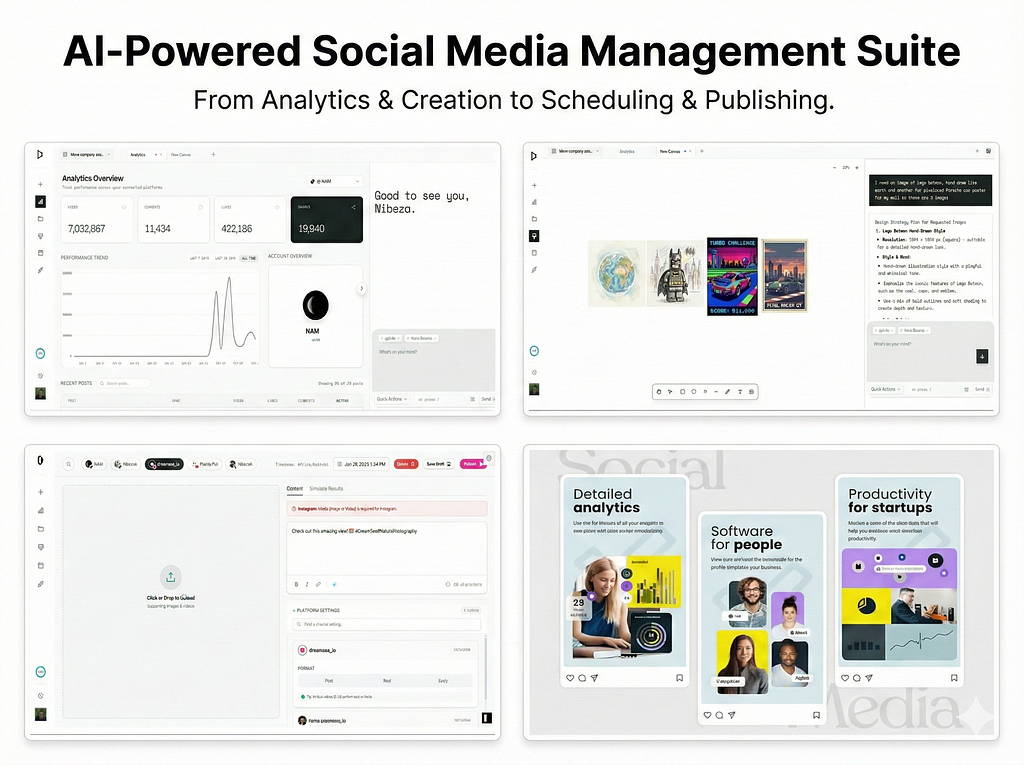
At Databrands, we started with the assumption that social media management should feel more like giving direction than executing tasks. Instead of telling people where to click, we asked what would happen if you could simply state your intent and let the system handle the rest.
Imagine uploading a year’s worth of content and describing how you want it distributed. The cadence, the platforms, the priorities. One instruction, rather than one hundred individual scheduling decisions. The system handles the mechanics, leaving you free to focus on what the content is actually trying to achieve.
The same principle applies to creativity. Instead of moving between disconnected tools, creation and publishing happen in one continuous flow. You design what you want, refine it, and release it without breaking concentration. Social listening follows the same philosophy. Rather than analyzing charts in isolation, you ask questions in plain language and receive clear, contextual answers.
What changes isn’t just speed, but mindset. When repetitive execution is removed, marketers regain the space to think. Campaigns replace isolated posts. Experimentation replaces maintenance. Creativity is no longer something you squeeze in between tasks; it becomes the main event again.
Databrands is built around that shift. It’s not about posting faster or scheduling smarter. It’s about removing unnecessary work so social media managers can spend their time doing what they were hired to do in the first place.
We’re launching Databrands on February 17th, 2026. If you’d like early access and free credits, you can request access through our Discord community here:
https://discord.gg/ZHTFaNkC
The future of social media management won’t be defined by better dashboards or more buttons. It will be defined by how much work disappears altogether.
Published originaly on Medium. View the official post for comments and engagement.
Go to original publication