The “100-Post Problem”: Why Traditional Scheduling Tools Are Failing You in 2026.
It’s February 2026. We have self-driving cars and AI that can write symphonies, yet social media managers are still stuck in 2015.
If you work in marketing, you know the drill. You have incredible strategic ideas, but you spend 80% of your day trapped in “tab hell.” You bounce between ChatGPT for copy, Canva for design, spreadsheets for planning, and a legacy scheduling tool to push the buttons.
We are drowning in operational overhead. And the tools we rely on — the Buffers, the Hootsuites — were built for a simpler time.
The “100-Post Problem”
Let’s be honest: Traditional scheduling tools are fine if you are posting the exact same link to Twitter and LinkedIn once a day.
But that’s not modern marketing. Modern marketing is hyper-segmentation. It’s distinct voices for distinct platforms.
Here is the scenario that breaks today’s tools: You need to schedule 100 unique pieces of content over the next 30 days.
You need different captions for TikTok vs. LinkedIn. Different aspect ratios for Instagram Stories vs. Feeds. Different posting times based on audience analytics.
Try doing that in a legacy scheduler. It’s a soul-crushing marathon of copy-pasting, endless clicking, double-checking dates, and manual tagging. It is death by a thousand clicks. You aren’t a strategist anymore; you’re a data entry clerk.
We realized that the problem wasn’t “scheduling.” The problem was the fragmented workflow preceding it.
Enter the Agentic Marketing OS
We decided to burn the playbook. We didn’t build another scheduler with a slightly nicer UI. We built the first AI-Native Marketing Operating System.
We are moving from a “click-based” interface to an “intent-based” workflow. We are building an Agentic workspace where you collaborate with AI to handle the entire lifecycle of brand management.
Here is a glimpse of what’s coming.
1. Command, Don’t Click.
Why click ten buttons to schedule one post when you could just say what you want?
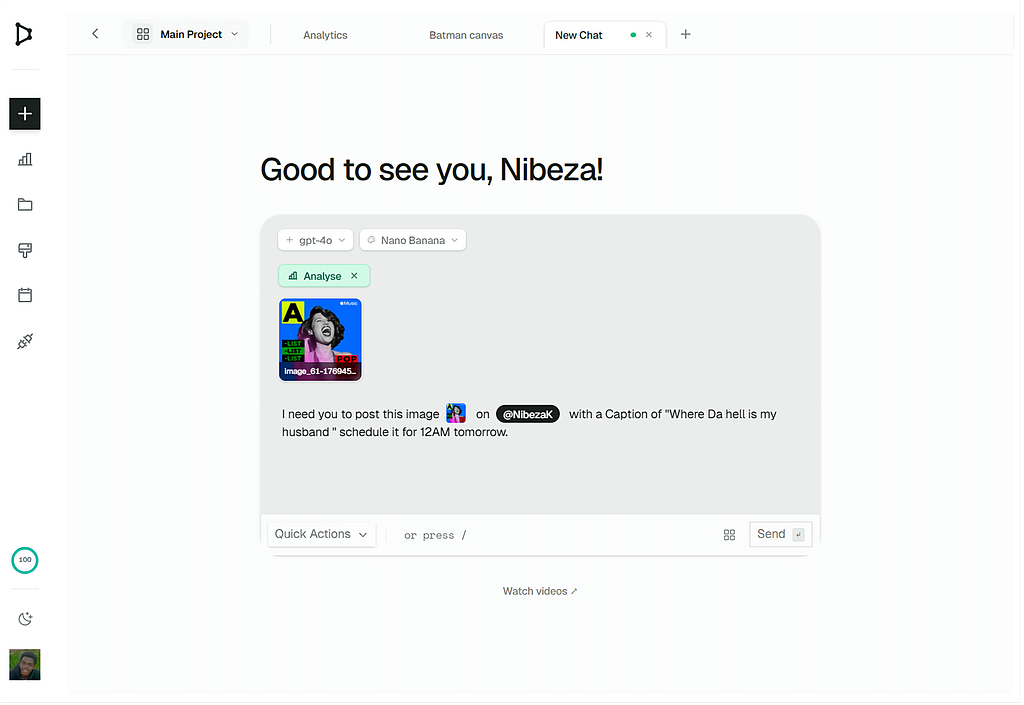
Our central interface is a natural language command center. You don’t navigate menus; you give instructions.
“Here’s an image. Post this to @NibezaK on Instagram with a caption asking ‘Where da hell is my husband,’ and schedule it for 12 AM tomorrow.”
The AI parses your intent, formats the post, selects the account, and sets the time. You review it, and it’s done. The friction of execution disappears.
2. The Creative Canvas
Strategy and creation shouldn’t happen in separate browser tabs. Our infinite Canvas allows you to drag in assets, brainstorm visually, and use multimodal AI to generate concepts right on the board.
Need to combine an album cover and a new photo to create a concept for a Spotify Wrapped campaign? Do it right on the canvas, then turn it into a post in seconds.
3. Conversational Analytics
Dashboards are great, until you have a specific question they weren’t designed to answer.
Instead of drowning in static CSV exports, we let you talk to your data.
You can ask: “Please compare the performance of the #sundusayaanle tag versus the #asadhagio1 tag on TikTok over the last month in a chart format.”
The system instantly generates the visualization you need. It’s like having a data analyst sitting next to you, ready to answer any question instantly.
The Shift Arrives on Feb 17th.
For too long, marketing tools have forced humans to think like machines — clicking, sorting, and filing. We believe tools should think like humans.
We are building the workspace that frees marketers to do what they do best: be creative and strategic, while the AI handles the heavy lifting of execution and analysis.
We launch publicly on February 17, 2026.
We are opening up limited spots for teams who are ready to stop clicking and start creating.
👉 Request early access now at trydatabrands.com
Published originaly on Medium. View the official post for comments and engagement.
Go to original publication